
Science Highlights
A candidate sub-parsec binary black hole in the Seyfert galaxy NGC 7674
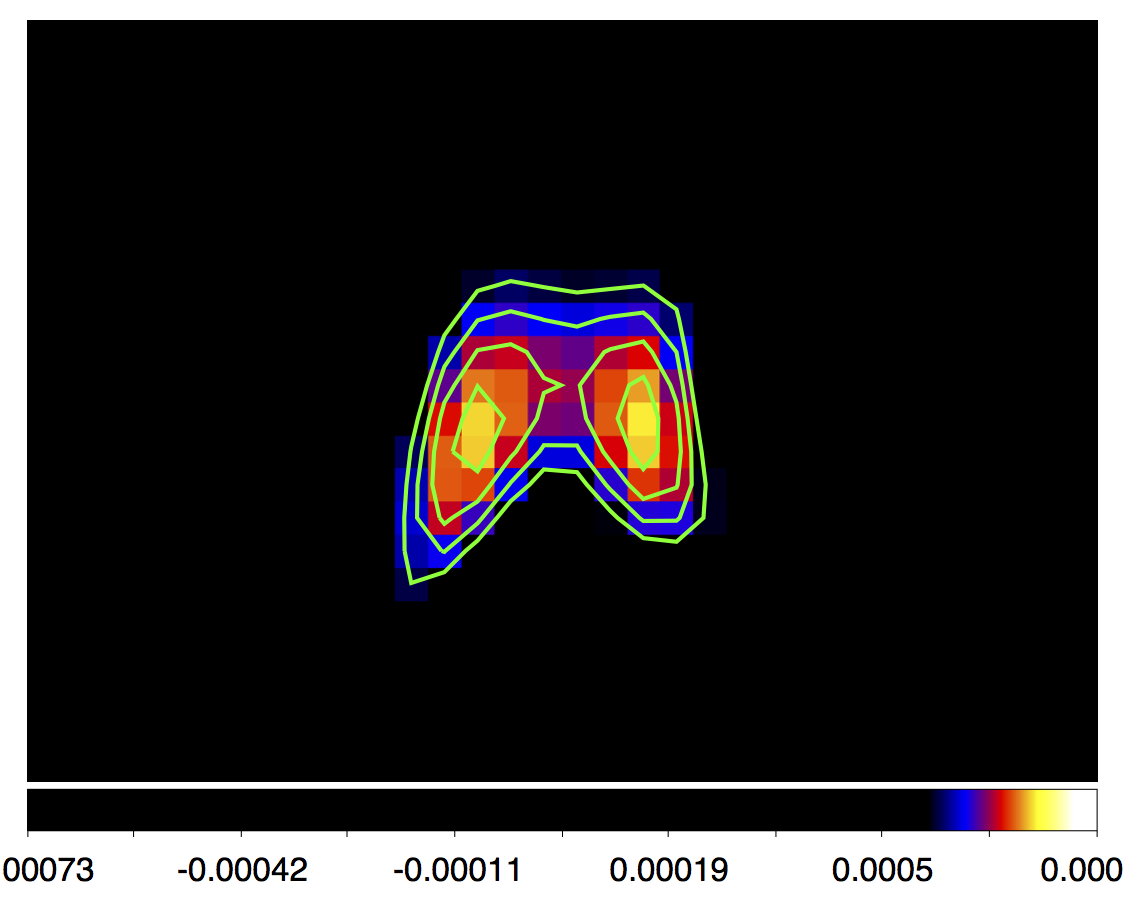
Kharb, Lal & Merritt have used Very Long Baseline Array (VLBA) observations to discover only the second candidate sub-parsec binary black hole. The existence of such binary super-massive black holes (SMBHs) is predicted by models of hierarchical galaxy formation, but only a single such binary SMBH has been imaged until now. Kharb et al. used the VLBA to study the gas-rich interacting spiral galaxy NGC7674, which possesses a kpc-scale Z-shaped radio jet. The leading model for the formation of such Z-shaped sources postulates the presence of an uncoalesced binary SMBH, created during the infall of a satellite galaxy. Kharb et al. used the high angular resolution of the VLBA to image the central region of NGC7674 at radio frequencies between 2 and 15 GHz, resulting in the detection of two radio cores, separated by just 1 light year, at the highest observing frequency, 15 GHz. The inverted radio spectra of the two cores are consistent with their being accreting super-massive black holes!
Discovery of a radio relic in the low mass galaxy cluster PLCK G200.9-28.2
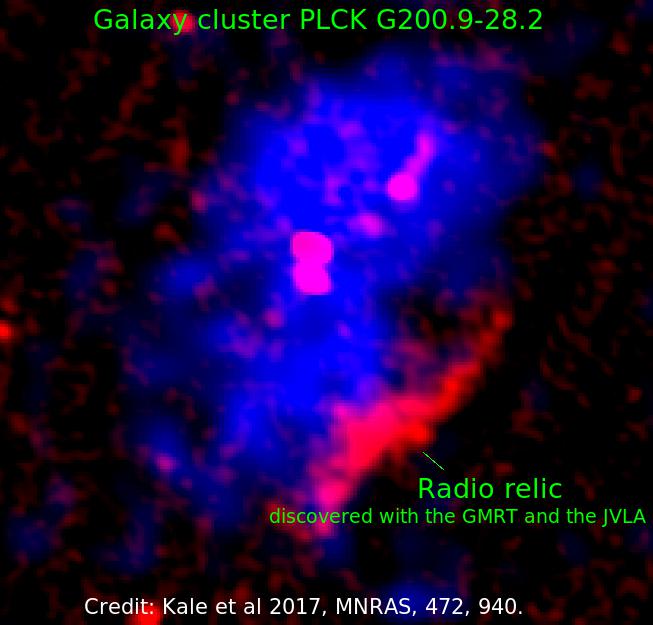
Kale et al. used the Giant Metrewave Radio Telescope (GMRT), the XMM-Newton X-ray Observatory, and the Jansky Very Large Array to discover a new radio relic in the galaxy cluster PLCKG200.9-28.2 at z~0.22. Such arc-like radio relics are usually found at the periphery of massive colliding clusters, and are extremely rare, arising in fewer than 5% of merging clusters. Despite their rarity, radio relics are an excellent tracer of the shocks that are expected to be driven in the diffuse intra-cluster medium by violent cluster collisions. Indeed, it is very difficult to even detect these shocks at other wavelengths. So far, radio relics have been found only in the vicinity of merging massive clusters. The new radio relic detected by Kale et al. is very interesting because it arises in a cluster of low mass, the lowest mass at which such a relic has ever been seen! This demonstrates that violent mergers in low-mass clusters are capable of producing strong shock waves in their diffuse media. In the adjoining figure, the 235 MHz emission imaged with the GMRT is shown in red and the X-ray emission imaged with the XMM-Newton satellite observatory is shown in blue. The elongated source seen in red is the new radio relic.
GMRT imaging of a high-energy supernova remnant
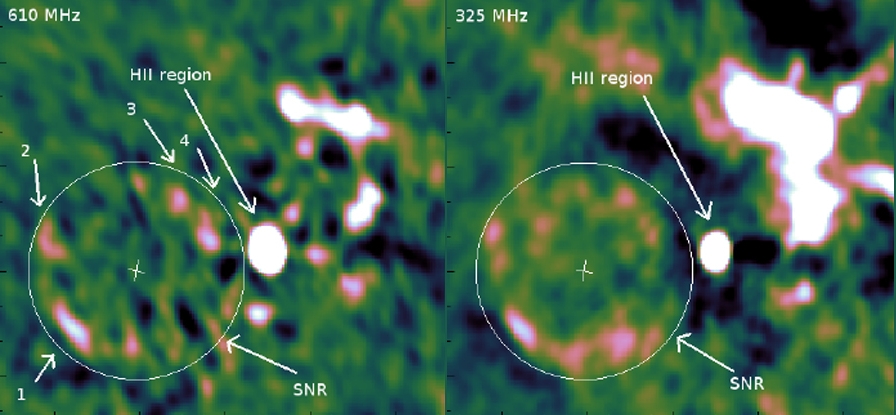
Nayana et al. used the Giant Metrewave Radio Telescope (GMRT) to detect 325 and 610 MHz radio emission from HESS J1731-347, one of only five known very-high-energy (VHE; > 0.1 TeV) shell-type supernova remnants (SNRs). Multiple filaments of the SNR are clearly seen in the GMRT 610 and 325 MHz images, shown, respectively, in the left and right panels of the adjacent figure. However, the faintest feature in the GMRT bands corresponds to the peak in the VHE emission. This anti-correlation can be explained if the observed VHE gamma-ray emission has a leptonic origin. The individual filaments of the SNR (indicated by \"1\", \"2\", \"3\", and \"4\") have steep radio spectra, consistent with a non-thermal origin.
An AGN s rendezvous with a radio relic
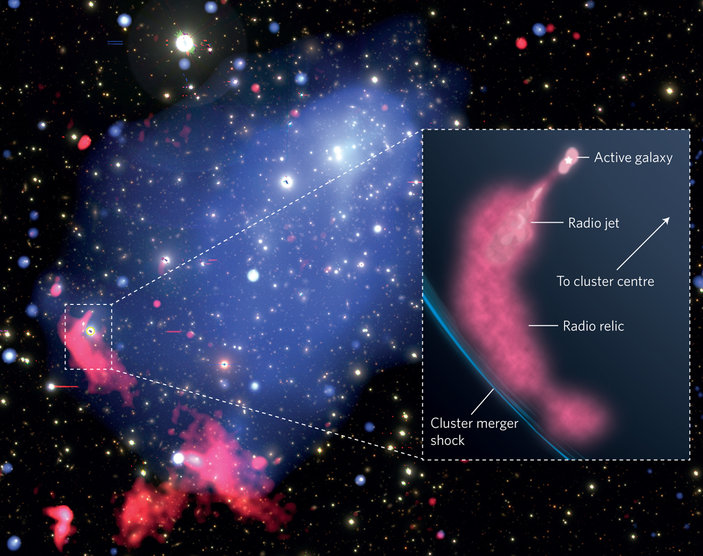
van Weeren et al. used data from the Chandra X-ray Observatory, the Giant Metrewave Radio Telescope, the Jansky Very Large Array, and other telescopes to discover a cosmic event never seen before. Galaxy clusters contain multiple sources of radio emission, including active galactic nuclei (AGNs), radio halos and radio relics. A long-standing problem in studies of clusters is how low-Mach-number shocks can accelerate electrons efficiently to produce the observed radio relics. van Weeren et al. discovered, for the first time, a direct connection between a radio relic and an AGN (a radio galaxy) in the merging galaxy cluster Abell 3411-3412 by combining radio, X-ray and optical data. This discovery indicates that fossil relativistic electrons from AGNs are re-accelerated at cluster shocks. It also implies that radio galaxies play an important role in governing the non-thermal component of the intra-cluster medium in merging clusters. For the first time, two of the most powerful phenomena in the Universe have been clearly linked together in the same system. Image credits: X-ray: NASA/CXC/SAO/R. van Weeren et al; Optical: NAOJ/Subaru;